
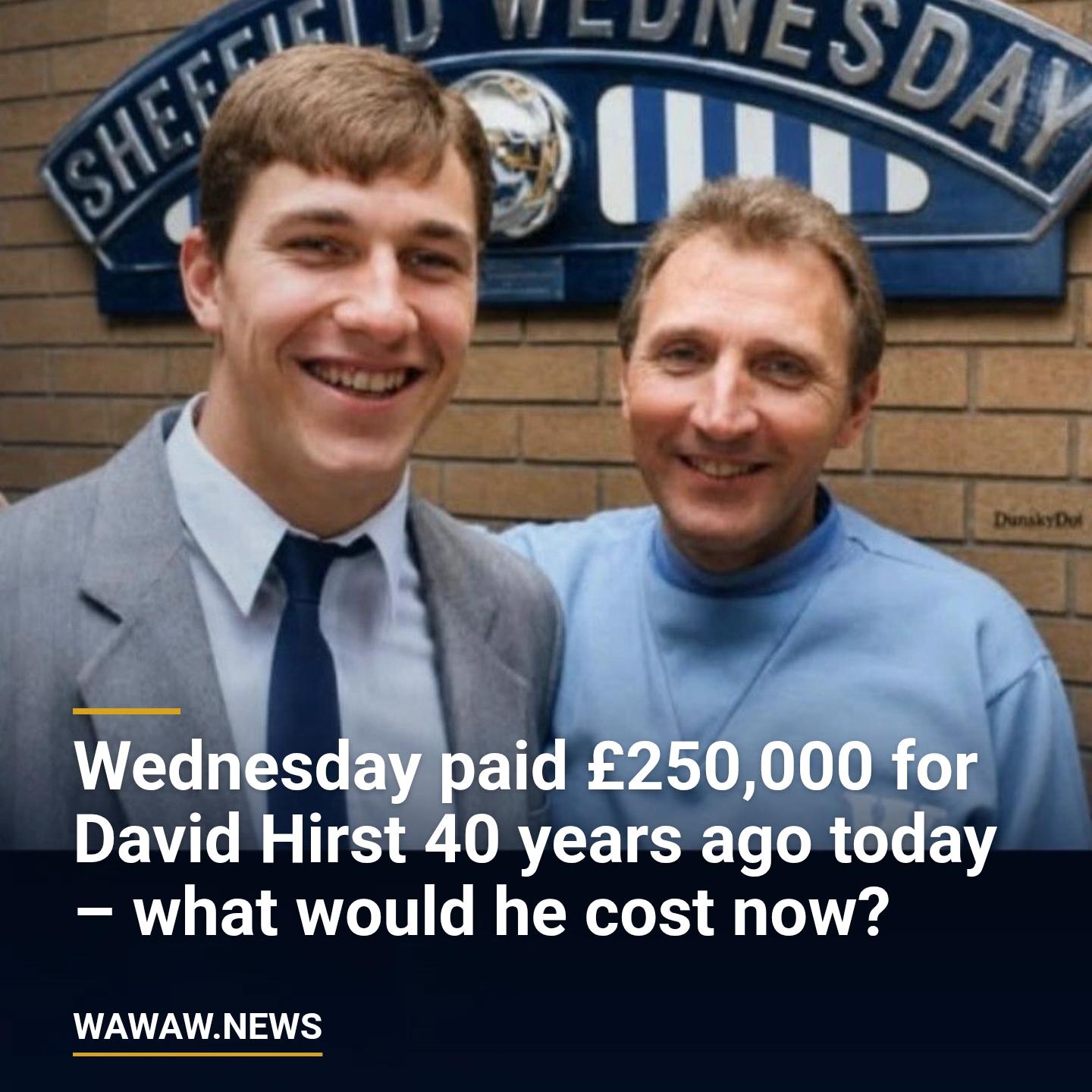
Forty years ago today, Sheffield Wednesday spent £250,000 on a 19-year-old striker from Barnsley.
His name was David Hirst.
On 11 August 1986, Howard Wilkinson brought the young forward to Hillsborough after Hirst had scored nine goals in 28 Second Division appearances during his first full season of senior football.
It turned out to be a fairly decent investment.
Hirst would become one of the finest strikers of his generation, an England international and, for many Wednesdayites, one of the greatest players ever to pull on the blue and white shirt.
But £250,000 sounds almost impossibly small in modern football.
So what would Sheffield Wednesday actually have to pay for the 19-year-old David Hirst in 2026?
£250,000 isn't really £250,000
The obvious calculation is inflation.
Using general UK inflation, £250,000 in 1986 translates to somewhere in the region of £800,000–£900,000 in today's money.
That tells us something about the value of money, but very little about the value of footballers.
Transfer fees have undergone their own extraordinary inflation over the past four decades. Clubs have become vastly wealthier, television revenues have exploded, international ownership has transformed the game and the amounts being paid for elite young talent bear almost no resemblance to those of the 1980s.
To understand Hirst's fee properly, we need to look at the football market he was bought in.
How big was £250,000 in 1986?
Hirst wasn't an established international or proven First Division goalscorer when Wednesday bought him.
He was 19.
He had played one full season for Barnsley and scored nine Second Division goals.
Wednesday were paying for what he might become.
For some context, Liverpool signed highly-rated Sunderland defender Barry Venison for £200,000 in July 1986.
Six months after Hirst arrived at Hillsborough, Liverpool paid Oxford United £750,000 for John Aldridge – an established goalscorer who had already helped Oxford climb through the divisions and win the League Cup.
And then there was Ian Rush.
In the summer of 1986, Juventus agreed a deal worth £3.2 million for the Liverpool striker – a British record transfer fee.
Suddenly, Wednesday's £250,000 investment doesn't look quite so insignificant.
It represented around 7.8% of the British record fee agreed for Rush.
And that gives us an interesting way of bringing Hirst's transfer into the modern era.
The £10 million teenager
The current British transfer record stands at £125 million following Alexander Isak's move from Newcastle United to Liverpool in 2025.
Take the same 7.8% represented by Hirst's transfer in 1986 and apply it to £125 million.
The answer?
£9.8 million.
It isn't a scientific valuation. Football transfers don't work neatly enough for that.
But as a measure of where Hirst's transfer sat within the market of his time, it provides a fascinating comparison.
Forget the £800,000 or so suggested by ordinary monetary inflation.
In football terms, Sheffield Wednesday's £250,000 signing in 1986 looks much more like a £10 million transfer today.
And viewed through that lens, the deal itself starts to make much more sense.
Wednesday weren't picking up an unknown teenager for loose change.
They were making a significant investment in one of the most exciting young forwards outside the top flight.
What would Wednesday actually be buying today?
Imagine the equivalent player appearing in 2026.
An English centre-forward.
Nineteen years old.
Already playing regular senior football.
Nine goals in his first full season in the second tier.
Quick, powerful, capable with either foot and regarded as having enormous potential.
Would £10 million sound outrageous?
Probably not.
In fact, given the premium attached to young English players and centre-forwards in particular, you could make a perfectly reasonable argument that the figure might be higher.
A range of perhaps £8 million to £15 million feels realistic, with roughly £10 million providing a useful comparison to Wednesday's investment four decades ago.
Of course, that's David Hirst in August 1986.
David Hirst a few years later is an entirely different conversation.
What about prime Hirst?
This is where comparisons become considerably more subjective.
At his best, Hirst possessed just about everything you would want from a modern centre-forward.
He was quick. He was powerful. He could finish with either foot. He could score from distance, run in behind, compete physically and create chances for himself.
He became an England international while playing for Wednesday and attracted interest from some of the biggest clubs in the country.
Drop a young English striker with those attributes into the Premier League transfer market today and you're no longer talking about £10 million.
You're potentially talking £70 million or more.
But Wednesday didn't pay for the finished David Hirst.
They paid £250,000 for the possibility of him.
Forty years later, perhaps the best way of understanding that deal isn't to say Sheffield Wednesday bought David Hirst for the modern equivalent of £850,000.
They bought a £10 million teenage prospect.
Then watched him become priceless.