
Who is Simon Wilson? The strategy-driven football executive close to Sheffield Wednesday move
Sheffield Wednesday’s new ownership group appear to be wasting little time in putting proper football structure around the club.
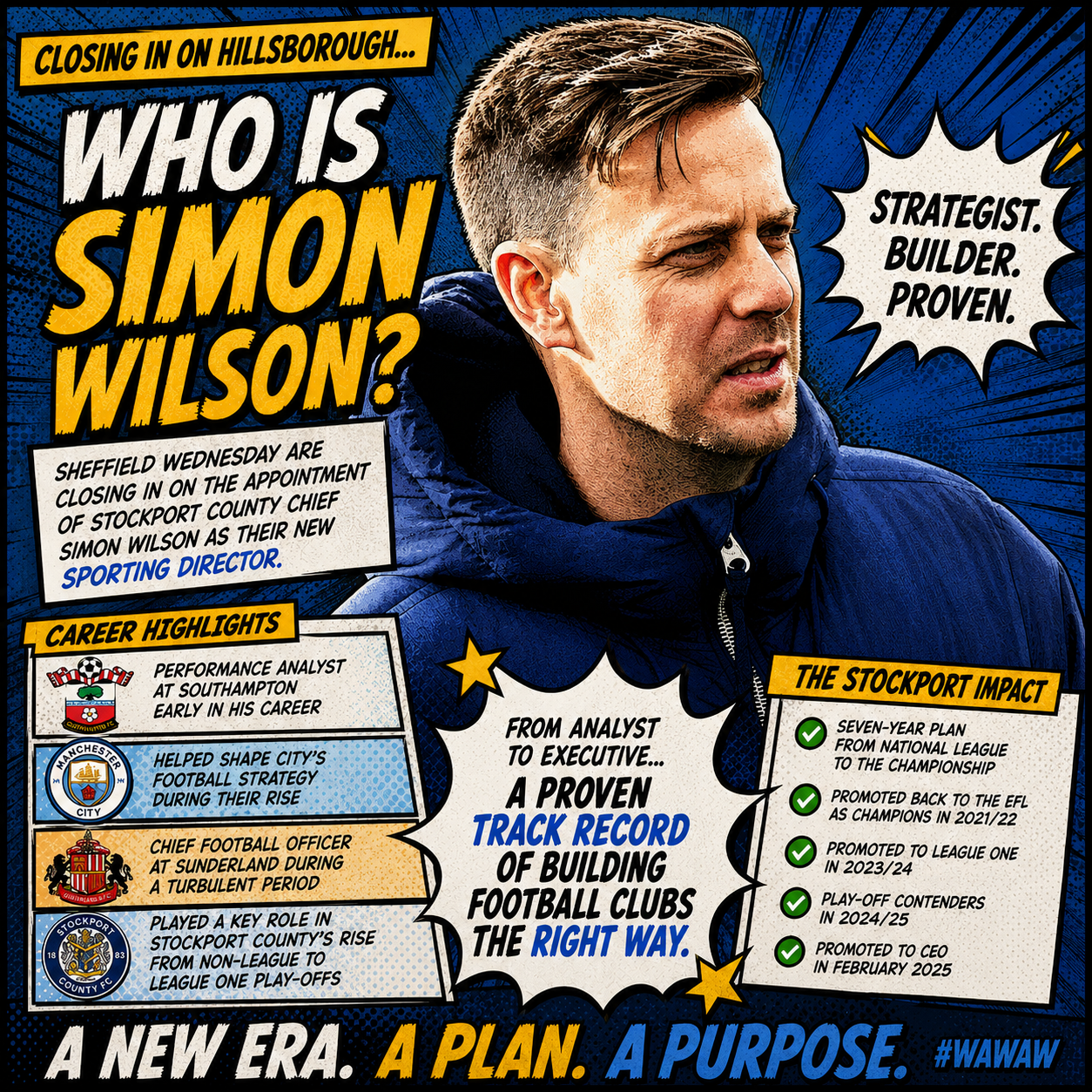
After the appointment of David Bruce as chief executive, the Owls are now closing in on Simon Wilson, the outgoing Stockport County chief executive, as their new sporting director. Reports from The Star and The Yorkshire Post suggest Wilson has been identified as the man Arise Capital Partners want to help lead Wednesday’s football rebuild, with the 43-year-old understood to have spent time at Hillsborough earlier this week.
For supporters, the name may not be especially familiar. But Wilson’s background is significant. He is not a traditional “transfer guru” or a figure whose reputation is built on one successful recruitment window. His career has been shaped around building football operations, creating long-term plans, and aligning clubs behind a clear strategic direction.
That could make him one of the most important appointments of Wednesday’s new era.
From analyst to football executive
Wilson’s career began in performance analysis at a time when that discipline was still emerging in English football.
After studying football science at Liverpool John Moores University, he joined ProZone, one of the early pioneers of football data and video analysis. He worked initially with Preston North End before moving to Southampton, where he became only the second full-time performance analyst employed directly by a club in the UK.
His time at Southampton exposed him to a club already looking for marginal gains. Wilson has spoken positively about working around figures such as Sir Clive Woodward, who challenged conventional football thinking long before ideas like dedicated set-piece expertise, game models and sports science integration became commonplace.
In 2006, Wilson moved to Manchester City. The club was very different then — far from the modern giant it would become — but his arrival came just before one of the most dramatic transformations in English football history.
He started as head of performance analysis, then stepped into broader strategy work during the early years of the Abu Dhabi ownership. Wilson has described being struck by the new ownership group’s mentality: less talk, more execution, with standards raised quickly across the club. He later said it was a mindset he carried with him into his own leadership career.
Helping build Manchester City’s football model
Wilson’s remit at City soon expanded. Working closely with Brian Marwood, he became strategic performance manager, supporting the development of the club’s football operation across recruitment, academy structure, training infrastructure and first-team support.
He later became director of football services at City Football Group, playing a role in conceptualising and establishing the multi-club model that would eventually stretch across clubs in Australia, the United States, Japan, Spain and beyond.
Wilson explained in a 2025 interview with Training Ground Guru that the aim was not simply to own multiple clubs, but to codify a methodology — a way of working that could be shared, adapted and improved across a network. That included recruitment systems, performance data, medical knowledge, coaching ideas and operational efficiencies.
That matters in the context of Wednesday because it points to someone who thinks about football clubs as systems, not a collection of isolated decisions. Recruitment, coaching, analysis, player development, budgets and identity all connect.
Sunderland: lessons from instability
Wilson left Manchester City in 2016 to become chief football officer at Sunderland.
It was a far more chaotic environment than the one he had known at City. Sunderland were living season to season, changing managers regularly, carrying an imbalanced squad and operating in a state of near-constant short-termism. Wilson later reflected that the experience taught him a great deal about what happens when a club lacks continuity and a coherent plan.
He said Sunderland showed him “the consequence of consistent changes to your plan”, and that the experience remains useful to him today.
For Wednesday supporters, that observation may feel especially pertinent. The final years of the Chansiri era were marked by instability, reactive decision-making and a lack of visible long-term football architecture. Arise’s early moves suggest they are trying to address precisely that.
The Stockport County success story
Wilson’s reputation rose sharply at Stockport County, where he arrived in March 2020 as director of football.
At the time, Stockport were still in the National League. Alongside owner Mark Stott, Wilson helped draw up a seven-year plan to take the club from non-league football to the Championship. It was an unusually explicit statement of ambition, but also a framework for decision-making across the club.
Wilson has explained that the point of the plan was not to create a rigid promise, but to give the whole organisation momentum and a common reference point:
“It’s like an aligning principle that gets everybody together to say, ‘Okay, if that’s what our intention is, what do we need to do to get there?’”
Stockport then delivered remarkable progress.
They won promotion back to the EFL in 2021/22, climbed out of League Two two years later, and have since established themselves among the strongest sides in League One. Wilson was promoted to chief executive in February 2025, reflecting his growing influence across the club as a whole.
When Stockport confirmed on 30 April 2026 that Wilson would leave at the end of the season, Stott paid a glowing tribute, saying it was “on record” that he would not have bought the club had he not met Wilson. The club described the first phase of its growth as complete, with Wilson stepping aside as Stockport prepared for a more sustainability-focused next chapter.
What is Simon Wilson’s philosophy?
The clearest picture of Wilson comes not from job titles, but from the way he speaks about football clubs.
He is clearly process-led and strategic, but not detached from the emotional realities of the game. In the Training Ground Guru interview, he acknowledged football’s unpredictability while stressing the importance of constant improvement, describing Stockport’s mantra as trying to create “better versions of ourselves” every day.
He also spoke candidly about the tension between ambition and financial control. Ahead of the 2025/26 season, he said Stockport had challenged themselves to reduce the playing budget while still improving the squad — a difficult balancing act, but one that reflects the growing reality facing EFL clubs.
Wilson’s comments on football finance were equally revealing. He warned that the sport cannot assume there will always be another owner willing to absorb losses, and argued that the game will need to think seriously about change if it wants to remain healthy over the long term.
That combination — ambition, structure, financial realism and football knowledge — likely explains why Wednesday’s new owners see him as such an attractive candidate.
Why he makes sense for Sheffield Wednesday
Wednesday are not simply rebuilding a squad. They are rebuilding a football club.
The post-takeover environment is full of hope, but the challenges are considerable. The first-team squad requires major work, the club is preparing for League One, and years of off-field drift have left gaps in structure, process and long-term planning.
Wilson’s appointment would suggest Arise understand that this cannot be solved through short-term excitement alone.
He has experience of:
- Designing and executing a long-term club plan
- Building football departments across recruitment, analysis and performance
- Working in both elite and lower-league environments
- Operating alongside owners with significant ambition
- Managing the trade-off between investment and sustainability
- Helping clubs move from disorder towards alignment
That profile feels highly relevant to Wednesday’s current position.
In particular, his Stockport work may resonate. Wednesday are a vastly bigger club, of course, but the underlying requirement is similar: create a plan, build the structure, recruit intelligently, align the departments and make sure the club is moving in one direction.
A notable signal from the new owners
If completed, Simon Wilson’s arrival would be another strong statement from Arise Capital Partners.
David Bruce’s appointment suggested the new regime wanted credibility, competence and improved relationships off the pitch. Wilson would add a serious football operations specialist to the senior leadership group — someone whose work has repeatedly centred on taking clubs from where they are to where they believe they can be.
For Wednesday fans who spent years asking for a proper football structure, that would be a meaningful development.
There is still plenty to do, and no appointment alone guarantees success. But Wilson’s background suggests Arise are not merely filling positions. They are attempting to build the kind of joined-up, modern football operation Wednesday have lacked for far too long.
Simon Wilson: Driving success with strategy at Man City & Stockport
Simon Wilson: Driving success with strategy at Man City & Stockport