
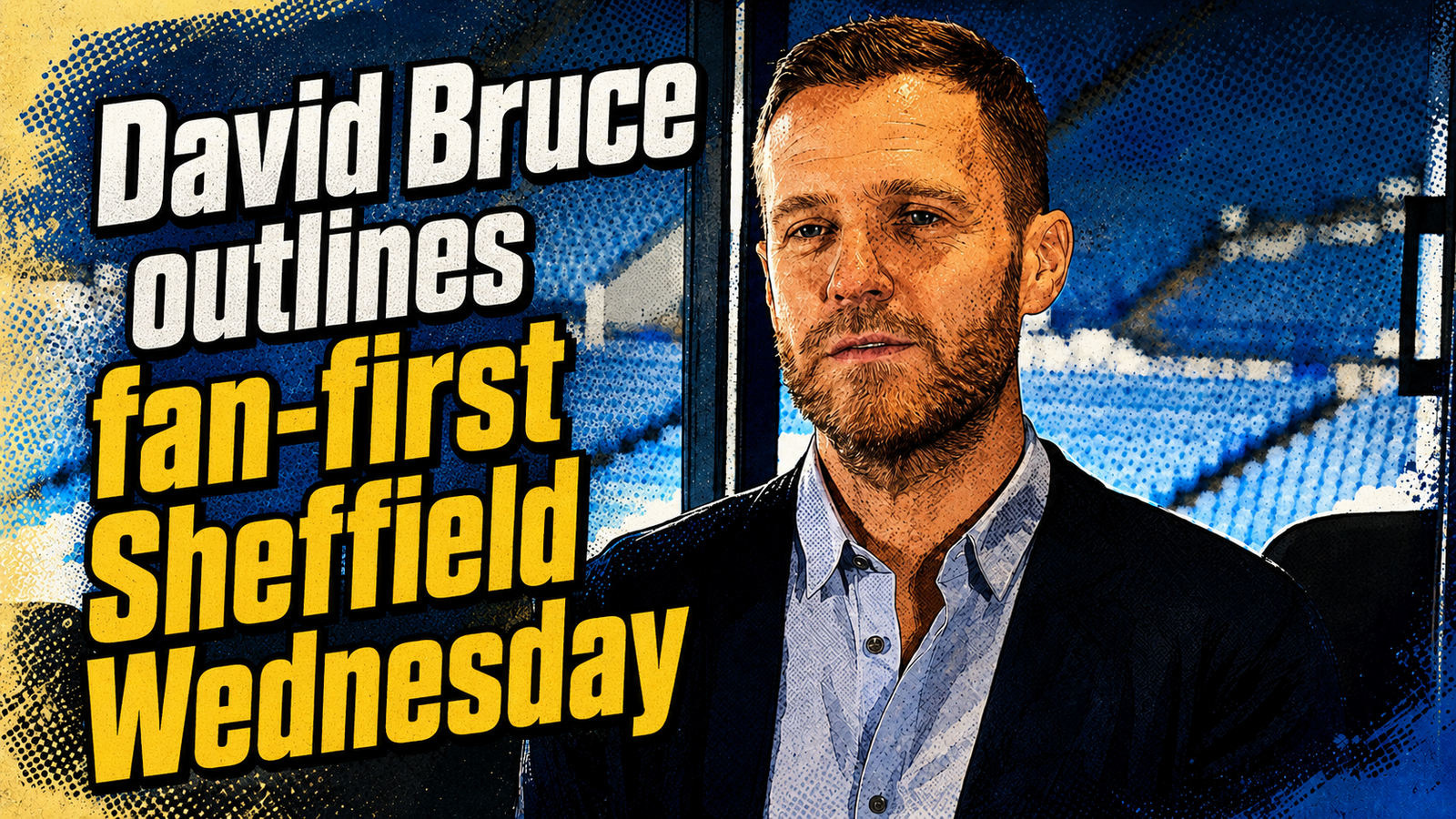
David Bruce has outlined a clear and ambitious vision for Sheffield Wednesday, describing the club as a “once-in-a-lifetime opportunity” and insisting that supporters will sit at the heart of the Owls’ new era.
Speaking in his first interview since being appointed chief executive, Bruce reflected on the scale of the task ahead at Hillsborough, but also on the enormous potential he believes exists within a club rich in history, tradition and global support.
For Bruce, Wednesday’s appeal was immediate. He spoke of the club’s “ingredients” — its heritage, its fanbase, its scale and its identity — as the foundations for a project capable of taking the Owls “to the next level”.
It was not simply a career move. Bruce framed the role as a rare chance to help restore one of English football’s great institutions.
“I don’t think there is a renaissance story and a rebirth story like this anywhere in European football right now.”
That language will resonate strongly with a fanbase emerging from one of the most difficult periods in the club’s recent history. Wednesday’s new ownership has already struck a markedly different tone, and Bruce’s interview reinforced that the early messaging is not accidental. The emphasis is on reconnection, rebuilding trust and making supporters feel part of the club again.
A chief executive with a personal Wednesday link
Bruce’s relationship with Sheffield Wednesday stretches back much further than his recent appointment. As a talented young goalkeeper growing up in the North East, he was scouted by the club and spent time in Wednesday’s old Centre of Excellence setup.
Though his playing career did not progress into the professional game, football remained central to his life. He later built a career in sports business, studying in the United States before spending more than a decade with Major League Soccer during a period of rapid expansion. He worked closely with ownership groups and executives across emerging clubs in markets such as Austin, Nashville, Miami and Los Angeles, gaining an understanding of how sports organisations build identity, commercial strength and lasting fan connection.
That was followed by three years at Sunderland, where he was part of a journey that took the club from League One to the Premier League. Bruce was quick to draw a parallel with Wednesday’s current position: a major club, operating below where it believes it belongs, in need of a structured rebuild rather than quick fixes.
“If you look after the fan, all the good stuff comes out of that”
The most significant theme of Bruce’s interview was his repeated insistence that Sheffield Wednesday must become a fan-first football club.
He said the new ownership group — led by David Storch — shared that same outlook from the very beginning of their conversations. In Bruce’s words, they are “kindred spirits” in the belief that a football club only functions properly when supporters feel connected, valued and represented.
That principle, he suggested, will shape not only external communication but internal decision-making across the business.
“Our vision, our strategy is going to have fans at the heart of everything that we do.”
Bruce acknowledged that, for a variety of reasons, some Wednesdayites had stepped back from the club in recent years. His message was that the new regime understands that choice rather than resents it, and that it is now the club’s responsibility to win people back through action.
That point was reflected in the immediate response to season ticket sales. More than 10,000 were sold within the first 24 hours of release, a figure Bruce described as “incredible”, and he made clear that the club would love to move beyond the previous record figure of around 21,000.
He also spoke about the thinking behind extending renewal pricing to anyone who had held a season ticket in the last five seasons, recognising that some supporters had deliberately withdrawn their financial support under the previous regime.
The early response, Bruce believes, suggests fans feel that “it’s a new day, it’s a new dawn” and that Wednesday is “a club reborn”.
Hillsborough, Middlesbrough and the power of the fanbase
Bruce also revealed the extent to which he immersed himself in the club before formally taking the job. Alongside his wife, he attended the away match at Middlesbrough anonymously, wanting to experience Wednesday’s support first-hand before beginning work.
He described the sold-out away following as relentless, defiant and impossible not to be swept up by, joking that he and his wife realised after half an hour they would have to start singing to avoid looking out of place.
The West Bromwich Albion game, where the new ownership was introduced to a packed Hillsborough, left an even deeper impression. Bruce called the atmosphere unlike anything he had experienced in sport, not simply because of the noise, but because of the emotion surrounding a fanbase that felt it had “got its club back”.
That experience appears to have shaped his conviction that Hillsborough can become a defining asset in the rebuild.
“We’d love to make this a cauldron.”
Bruce argued that if Wednesday can recreate anything close to the West Brom atmosphere on a regular basis, it will become a powerful force not just for the players, but for recruitment, commercial partners and the club’s broader appeal.
The immediate priorities: stadium, squad and commercial growth
While much of the interview focused on philosophy and culture, Bruce was also clear about the practical work already underway.
He identified three immediate building blocks:
1. Stadium and training ground infrastructure
Bruce said the club had “not messed about” since the takeover, with urgent work beginning at Hillsborough and the training ground. Some of that work, he admitted, may not be glamorous, but it is essential.
He referred to basic operational standards, including fundamental stadium issues that should have been addressed previously, and said there would be a focus on safety, food and beverage, retail and improving the matchday experience where possible over the summer.
2. Football operations and recruitment
On the playing side, Bruce stressed that Wednesday would need to be “really aggressive and active” in the market ahead of life in League One. The club has already released its retained list, and he indicated that transfer planning is progressing around the style of football Henrik Pedersen’s side wants to play.
He also acknowledged that some players may attract interest, particularly younger talents or those who have previously operated at a higher level, and that the club must manage those situations carefully.
One of the most notable updates concerned the sporting director position. Bruce confirmed that Wednesday have identified a preferred candidate and are optimistic of further news in the coming weeks.
3. Commercial reset
Bruce was equally direct about the commercial side of the rebuild. Shirt sponsorship, sleeve sponsorship, premium spaces and other club assets are expected to go to market quickly as Wednesday look to build the revenue base required for sustainable progress.
He also believes Hillsborough’s hospitality and premium offering can be reimagined, creating improved experiences for supporters and partners alike.
The message was clear: the club has a great deal to do in a short period of time, but the executive team is already moving with urgency.
Long-term ambition, not short-termism
Perhaps the most encouraging element of Bruce’s interview was his insistence that Wednesday’s rebuild cannot be defined solely by the next transfer window or the next league campaign.
He repeatedly referred to long-term health, sustainable progress and the need to restore trust not only with supporters, but also with players, agents and the commercial community. The club, in his view, must move quickly this summer while also resisting the temptation to think only in short bursts.
That is a significant change in tone.
For years, Wednesday supporters have watched plans unravel amid short-term decisions, poor communication and declining confidence. Bruce’s words will not, on their own, solve that. But they do provide a framework for what the new era appears to be aiming for: competent leadership, fan-centred thinking, commercial modernisation and football decisions aligned to a wider strategy.
The hard work starts now. But after his first substantial interview, David Bruce has made one thing abundantly clear: Sheffield Wednesday’s new chief executive understands both the size of the opportunity and the weight of the responsibility.
And for a fanbase desperate to believe again, that is a meaningful place to begin.